



What is a zavetina?
On certain days of the year, the entire village gathers. Offerings and gifts are then dedicated to the dead, and a circle dance is formed in their honor. The music is sad then, and the dancing lasts no later than midnight. There are, however, festivities when the entire village celebrates an important village or religious saint. The gathering place is sacred and is called zavetina or zapis. If there is no zavetina in the hamlet, then the customs are observed in some clean place – by a stream or a spring.
Learn more about another custom that still lives in the village of Zlot: „Cveti“.
How to recognize the record?
Some customs are simply impossible to separate from rituals. Pomanama which are dedicated to patron saints' days that are celebrated, and which are organized at the village zapis, are preceded by two unusual rituals. I rank the entire ritual among my absolute favorites.
Lightning will strike a tree a few times during the year or perhaps over a series of years without anyone knowing why that particular tree. Probably because it is marked. The place of a lightning strike can also be some rock near houses. Strange things will happen in the surroundings afterwards. Just like that, sparks, electricity, and fires appear. By themselves. There are those women who know how to recognize signs just like a doctor connects symptoms before a diagnosis. Old woman Veselina is one of those.
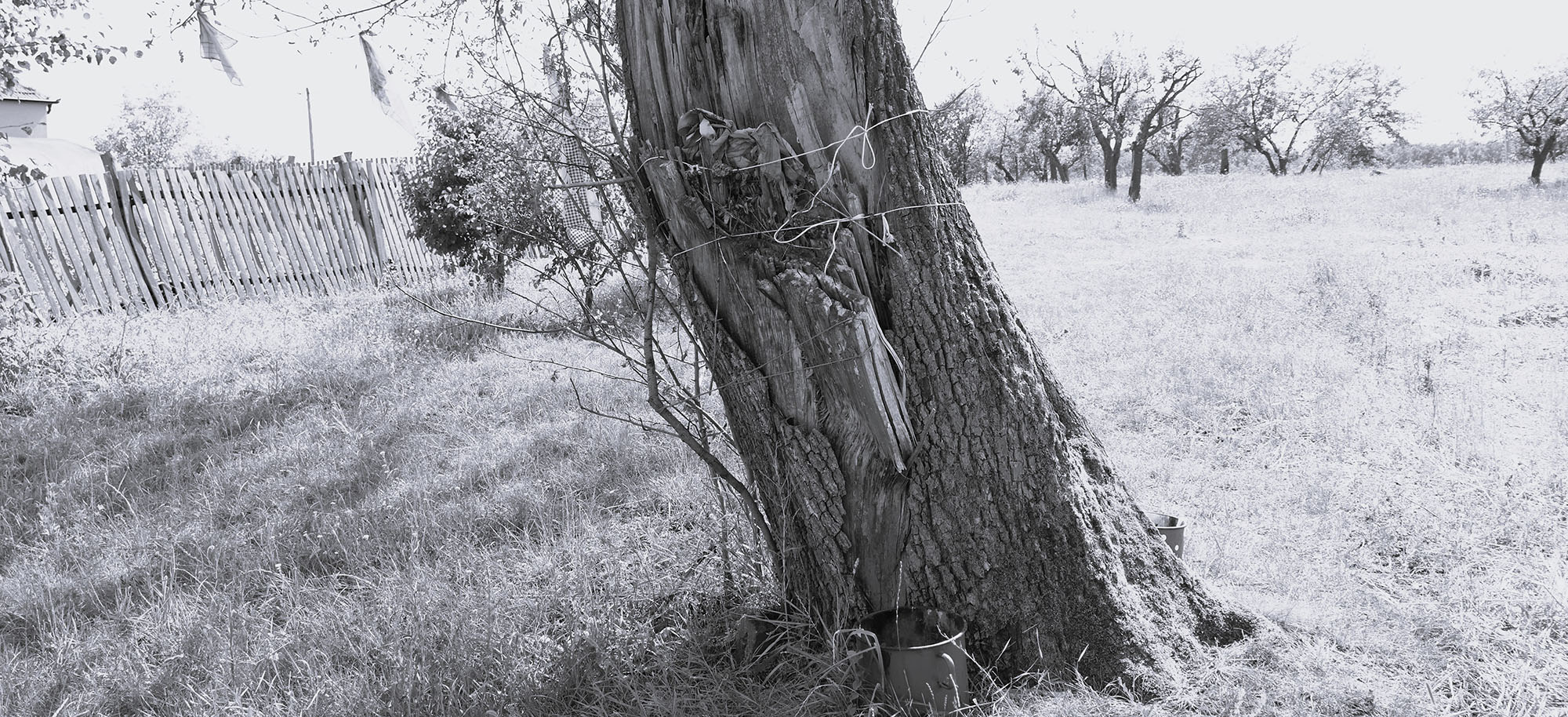
The zapis shrines go up to the number three. There simply cannot be more than that in one village. Often the votive tree is a service tree or some other tree near someone's house. How else would the villagers notice any events if they were at a distance?
If a tree is old, decaying from the bite of time or the strike of the wind, parts will fall from its canopy. Those remains do not go into the fire. By no means! Because it is pure and sacred. Those parts are dragged away somewhere where people and animals do not wander. Where a dog will not piss on them. Each of the three sacred records, although there may be two or only one, covers a part of the village in its surroundings. If the villagers do not respect the one closest to them, bad things will happen to them.
Cleaning – establishment of the village patron saint's day feast
The cleansing takes exactly nine weeks. That is the only way to establish the true existence of the new record. Every Saturday morning, in a room adorned with icons—44 of them—the aforementioned ritual is performed. Grandma Veselina knows how.
The housewife whose country is marked must take nine lumps of salt to the old woman's home on the first Saturday. The granny will use all her knowledge chanting over them.
Next Saturday morning, regardless of whatever obligations the property owner may have, she must provide nine sugar cubes. The chain must not be broken at any cost.
On the third Saturday, take away nine grains of incense. The corresponding spell will also be performed for that day.
It is then necessary to obtain nine sprigs of basil.
The cycle continues with spellcasting over nine coins.
The sixth Saturday awaits nine oak shoots. That part can be particularly demanding.
Sobu will then light nine candles.
On the penultimate Saturday morning, the ritual will be performed over water that the housewife must draw into three bottles. The old woman will pour it into nine vessels. The first amount is for entering, the second for cleansing, while the third is for exiting. Water brings, washes away, and carries off.
The circle of cleaning is closed with a bottle of wine. In nine separate containers, it goes without saying.
The ritual bread is kneaded on Fridays before every Saturday. All procured items and the ritual bread must be wrapped in clean white linen before and after the ritual. The water and wine are consumed in the house, while the other items are left beneath a fertile tree or at an existing sacred tree shrine (zapisi). The bread is shared among the household members, while a portion is designated for the livestock in the household.
Search – Record Confirmation
The search is being conducted in order to find the center of the zavetina – that tenth Saturday.
The lady of the house, where the unexplained is happening, must bring the old woman to the place where the lightning struck. It is often impossible to know with certainty which tree the heavenly light touched. Especially if there is a cluster of them on the estate.
On the way to the search site, occurrences that are not exactly usual may follow. A swarm of bees above the heads of the two women being followed is considered a good omen. Crossing the path of a snake, on the other hand, bodes no good at all.
The record will have a cross carved into its bark or a marker cut into stone. After a successful search, the old woman will truly Bajali Com, with a hawthorn cross and a burning oil lamp, to establish the exact date of the village slava. A lightning strike often coincides with one of the three days of Trinity. If there are all three shrines in the village, each will be tied to one of those three days. There is no doubt about that. There is no mistake there.
The village shrine tree protects the family and livestock, estates, and the entire village. Beneath such a tree, all important rituals will be performed, memorial services dedicated, slavas celebrated, and even Easter and Christmas. The holy site is adorned with small pots, kitchen towels, towels, and other gifts. Small ritual breads, *preskuri*, are dedicated in the shadow of the sacred tree to the three fates—known from village to village as *ursaturi*, *raturi*, or *suraturi*. A fourth bread is also prepared, and that one is dedicated exclusively to the village patron saint day.
On important days, all those elements—those nine—are offered, along with oil as well. The best gifts are set aside for the 44 saints, in calendar order. And the colors must also be respected. Black socks are always dedicated to the Mother of God on her votive day.
Family and tribe members attach themselves to saints, each to their own according to their birth date. You do not go to the sacred tree record with an axe or a saw! There is no holier place in the neighborhood! Like a monastery or any other place of worship. The votive day is marked with crosses and is anointed with wine.
Source: Ljiljana Bukić from the village of Zlot
Author: Aleksandar Bogdanović
Leave a Reply